Thursday, 23 January 2014

Time

Some years ago I looked for a simple clock to have an accurate time available in my shack.
I found a nice design on this website:


http://www.picbasic.nl/  => Projecten => Digitale DCF77 klok
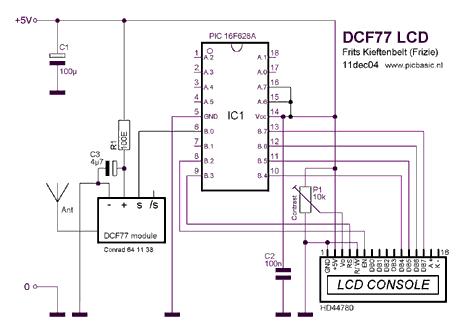
Circuit diagram DCF77 clock


I built the simple version (without sound) at the time and the clock is still working fine.
The clock uses a 16F628 PIC and a DCF77-module.
I selected a nice blue display to present the time.

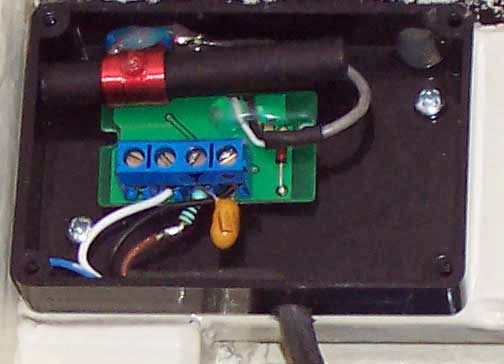


                                                 DCF77 receive module

The longterm accuracy of the DCF clock is ok for normal use: After one year the deviation of the second is no more than +5 to +150 msec.

 
 Clock in operation

All about the 77.5 KHz  DCF77 transmitter in Mainflingen:
http://en.wikipedia.org/wiki/DCF77


Saturday, 18 January 2014

60 meter band RX results

The 60 meter band or 5 MHz band is a relatively new amateur radio allocation (not strictly a band), first introduced in 2002, that was originally only available in a few countries, such as the United States, United Kingdom, Norway, Finland, Denmark, Ireland and Iceland.

Lying approximately halfway between 80m (3.5 MHz) and 40m (7 MHz), the 60 meter (5 MHz) band forms a communication bridge when propagation effects make use of 80 or 40m impossible for local-to-medium distance communications.

 
Since in Holland we are not allowed to transmit in this band (yet), I tuned into the 60m band on the WSPR frequency 5.2872 MHz. Received G en OZ stations:


All about the 60 m band:

http://en.wikipedia.org/wiki/60-meter_band

Minima

Ashar Farhan has launched his new design: The Minima. This is a QRP general coverage shortwave transceiver intented for homebrew purposes. Covered frequency range is 0-30 MHz and RF output is appr. 1 Watt. An additional PA must be used for easy operation. 


A digital display enables you easy frequency adjustment. A Si570 is used in the (double) VFO. A high IF of 20 MHz is choosen. Parts of the design are also used in the famous BITX transceiver of Farhan.

 "Manhattan" style buid-up


You can read everything about this nice rig here and join the mailing list: 
http://www.phonestack.com/farhan/minima.html


Smart design of the Minima:

Thursday, 16 January 2014

28 MHz propagation after sunset

Interesting to see how the 10 meter band behaves after sunset. Yesterday evening WSPR activity with G and D was seen on my QTH JO22gb. The path crossing the ocean was with K9AN earlier that evening during daylight. I used 5 Watts RF into a G5RV jr antenna.

When thinking about the amazing results of WSPR last years I sometimes have the idea that there must be an undiscovered phenomenon that enables us to make worldwide WSPR links with less than 100 mW RF power. How about curved shapes in the propagation layers (like parabolic mirrors) that focus/concentrate the RF energy at the receiving spots ?


Saturday, 11 January 2014

BITX20

This morning I blew away the dust on top of my homemade BITX20 transceiver. I built this device in 2008 at the clubstation PI4RAZ in Zoetermeer. If you look up BITX20 in the forum of www.pi4raz.nl  you can recall all the details of this project at that time.


Home made BITX20 on top of Yaesu FT450


Manhattan style build-up


The BITX20 is capable of providing an RF signal between 5 and 10 Watts. In my design two IRF510 mosfets have been incorporated into the PA.

When switching on the device this morning, to my surprise, it worked immediately.
Hooked up the G5RV jr antenna and ATU and in an hour time I was able to make 3 QSO's:

IZ1GRH, Stefano, Nr. Milano, 14.217 MHz
IZ6FXP, Al, North-Italy, 14.250 MHz
C37SBX, Andorra, FIS special callsign, 14.215 MHz

This last contact was a nice suprise. This special event station from Andorra is only active during this weekend (11/12 Jan. 2014). It is a special event station related to the FIS World Cup.


Power Amp with 2 IRF510 MOSFETs

Sunday, 29 December 2013

HDR photography

Although not directly related to the radio hobby this part of the photo hobby might be interesting for you as well.

Yesterday we went to an area called Noord-Aa in Zoetermeer. I gathered some photoos with my Canon EOS1000D camera. Used a tripod for proper stabilization. The photoos I took, were a mix of overexposed, underexposed and normal exposed recordings, serving as building blocks for my first HDR pictures.

Joachim Seibert, PA1GSJ, reported on his new blog about HDR  (High Dynamic Range) photography:
http://recordingphotons.blogspot.nl/2013/12/handheld-hdr-photography.html

I used the freeware program "Picturenaut3.2". This program allows you to upload a number of pictures and merge them into one picture with more/different details.

These are my first "acceptable" results:


Thursday, 26 December 2013

24 VDC switching power supply

While cleaning up my attic I found this module. Reading the label revealed that it is a switching power supply, capable of delivering 24Vdc @ 2.5 Amps.
Nice design; it is very small (appr. 10 x 5 cm) so it can be incorporated into existing designs. Have to think of an application for this 60 Watts toy.

Saturday, 21 December 2013

Double duplex QSO

Yesterday I had a remarkable QSO with Hans, PE1DWA.
We had set up a duplex ATV connection and a duplex voice connection.
For ATV we used the repeater frequencies of PI6ZTM (10,150 GHz out, 1255 MHz and 433 MHz in).
For voice 2 meter and 4 meter band were used: 144.750 MHz and 70.450 MHz.
So in total we used 5 different frequencies. At least remarkable.
I made a map this event:


Except for the ATV transmission on 70cm (which was in AM, one suppressed sideband) all transmissions were in FM.

Tuesday, 17 December 2013

> 10k pageviews

Today the number of pageviews exceeded 10,000.
Thanks visitors and readers of this blog !
Happy Xmas and new year for all of you.


Sunday, 15 December 2013

1.2 GHz biquad antenna ready

Today I finished the biquad antenna. It is a lightweight version of another biquad I used before. This evening I fixed the antenna onto roof. 
Opening the attic window to stick the antenna outside is not necessary anymore which is good since winter temperatures are approaching.


             Here you see the antenna with a bunch of RG6/U coaxial cable (10 meters)


                                                         This is how I started


To make the antenna moisture proof a transparant box was glued over the element

Antennas on the roof. In front LNB for 10 GHz RX in the back the 23 cm biquad for TX

The antenna is connected to the ATV transmitter via 10 meters of coaxial cable. I intended to buy hi frequency low loss 50 ohms coax like H100 or Aeroflex. But the prices of this type is rather high. About 4 euro's each meter. In the "Praxis" they sell RG6/U  75 ohms coaxial cable for regular satellite receiver use. A bunch of 10 meters sells for 10 euro's. I thought the difference between 50 and 75 ohms is not that much (SWR of 1:1.5 and reflected power is only 4%). This appeared to be true. My ATV signal is copied in good quality by the repeater. The specifications show that the attenuation of 10 meters RG6/U is approximately 2.5 dB at 1.2 gigahertz . Not that bad.

You can find the dimensions of the antenna in my blog article of September 2013.