Saturday, 1 August 2026

Regenerative receiver

 A regenerative receiver uses positive feedback to increase amplifcation significantly. The principle was invented around 1912 by Edwin Armstrong, so the early days of radio. The principle enables you to design one or two tube (or transistor) radio's with loudspeaker output.

The radio has one disadvantage; you have an extra potentiometer to adjust the level of amplification (regeneration in fact). So this type of radio is interesting when you like to fiddle around with buttons and knobs.

I ran into a design of Jack Donio. It is an 0V1. Since I had a bunch of retrieved components from a Blaupunkt tube radio I started building the design.


As you might know I am fascinated by radiostuff from the pre-transistor area; I built this radio with a positive result. I made some small adjustments; the complete PSU was available from the old Blaupunkt radio so I used that. Also I used the tube ECC85 instead of ECC81. I did not make the coil according the instructions but I had one, very similar, in the junk box. 


The radio turns out to be quite sensitive. The EL84 provides sufficient audio output. The frequency range is 9..15 MHz. Last days, especially in the evening, there are a lot of broadcast stations to listen to. I heard China, Bulgaria, Iran AM stations. The best way to receive AM signals is to find the spot where the receiver is on the edge of oscillating. Of course you need a long wire antenna (at least 10 meters).

The variable capacitor on the left is for coarse tuning. The one on the right for fine tuning. The last one is required to tune into HAM radio signals in the 10 MHz and 14 MHz band. To my surprise I heard quite a lot of CW signals. The SSB signals in the 14 MHz are quite hard to adjust to. But not impossible. You need care to play with the fine tune capacitor and the regeneration potentiometer.


I also added an EM80, the green magic eye. Just for fun.


I am now in the phase of final adjustments and putting some placards near the controls. It was a fun excercise in building vintage radio in this era of microchips, semi-conductors and plug-and-play transceivers from Aliexpress.

Wednesday, 14 January 2026

High Altitude scanning

I had the opportunity to use my scanner GRE PSR-225 on the 12th floor of an appartment in Rotterdam Zuid. It was fascinating to experience the easy reception of VHF/UHF signals at this altitude (appr. 40 m above sea level).

                                       Scanner GRE PSR-225 with 70 cm antenna on balcony

Some signals were very loud. Of course the VHF/UHF repeaters in Rotterdam, Leiden and Den Haag.
AM signals from Rotterdam-The Hague airport on 118.200 MHz were crisp and clear. Also marifoon signals from vessels on the Nieuwe Maas river between 156 - 161 MHz were interesting.

The use of  PMR frequencies 433.200 and 433.300 MHz was apparent. I wonder can we, ham operators, use more than 0.5 Watts on those PMR channels ?
I hoped to receive 23 cm signals, but was unsuccesful. I focussed on the Rotterdam repeater at 1298.625 MHz, but nothing heard there.

Anyway it was nice to use my scanner GRE PSR-225 after a long time again. Interesting device for sure ! PSR-225


Tuesday, 30 September 2025

144 MHz FT8 communications

I was curious to see if an old 2 m transceiver was able to handle FT-8 signals. Therefore I removed the dust from my 40 year old Sommerkamp FT-480R and connected it to my pc via  a simple interface.


After waiting a few minutes, the internal oscillator of the FT-480R appeared to be stable enough to make good FT-8 contacts. Both in low power (1 Watt) and hi power (10 Watt) I could make nice QSO’s around 144.175 MHz. FT-8 activity in UK, B, F and D allowed me to make contacts with the neighbour countries .


Thursday, 10 April 2025

145 MHz transverter

Currently I am working on a 145 MHz - 50 MHz transverter. I combined various circuits and built it in Manhattan Style. 

The core is a 96 MHz oscillator that enables me to tx and rx from 144...146 MHz in all modes available (FM, SSB, AM) on the HF transceiver (dial IF 48...50 MHz). 

Blockdiagram is as follows:


Ordered a nice frequency counter and DVM from Ali and drilled some openings in the casing to incorporate them.

Yesterday I made my first QSO with Rob PA0RPA on 145.625 MHz via the Bergen op Zoom 2m repeater (The HF transceiver enables the use of -600 kHz freq shift / 88.5 Hz tone for repeater use)

I still have to connect the 250 uA meter. I will install a simple fieldstrength detection circuit for it.


First results in SSTV mode look promising;


Received from PE1NYG in Pijnacker via SSTV repeater PI1DFT on 144.8875 MHz in Delft.


Sunday, 9 February 2025

OZ on 160m

I made some nice QSO's on 160m, 1840 kHz, lately. Of course my longwire antenna is much too short for this band, nevertheless I was surprised by the amount of stations I could see in FT8.

Jan, OZ1ADL, rewarded one of the QSO's with a nice eQSL.


Friday, 1 November 2024

28 MHz activity

I hooked up my FT450 with longwire antenna to explore the 10 meter band. There is a lot of activity ! A lot of stations on 28.074 MHz  FT-8 as well. I made some QSO's. I received a remarkable eQSL card from SV3AUW from Kalamata, Greece. I think the homebrew PCB on his card shows a nice X-tal oscillator, right ?


Friday, 11 October 2024

73 from the past

I found a nice eQSL this morning from Urugay in my inbox. It dates back to 2006. In that time I was quite active with PSK31:


Tuesday, 23 July 2024

Medium Wave LPAM transmitter

I did some experiments with the receiver IC KT0936M lately. I built a simple SW and MW receiver with this chip. To be able to do some experiments with the MW radio I thought it would be a good idea to make a small MW LP (Low Power) AM transmitter. 

                            Medium Wave receiver with KT0936M


For reasons of stability I started with a 1015 kHz crystal oscillator. The modulation of the transmitter is done by a 5W LF amplifier TDA2030A. The output of the LF amplifier goes into the input of the small transformer in the DC supply line.

I used a 2N2219A  as PA stage. I think it delivers about 500 mW. A pi-filter provides the proper interface to the antenna.

MW LPAM Transmitter schematic


With this low power AM modulated medium wave transmitter I have a good radio signal in the house. Of course our radio liscence does not permit the use of this transmitter for broadcast purposes. 

MW LPAM transmitter 


The LF amplifier;


Friday, 31 May 2024

70 MHz Sporadic E contacts

This week now and then the 4 m band opened because of Es.
I made FT8 QSO's with Spain (EA6SX) and Greece (SV2DCD, SV2JAO..) on 70.154 MHz
One QSO has already been confirmed by eQSL:


Path to OH is also open once in a while;


Friday, 17 May 2024

Radio Caroline

Lately I have been experimenting with a KT0936M module on the medium wave. I discovered that Radio Caroline puts a firm signal strength at 648 kHz at my QTH. The music they play is from the 60’s-90’s. Like to hear their music through my 5 Watt tube amplifier 😊

Here   https://www.radiocaroline.co.uk/#648_am.html   you can read that Radio Caroline returned to the medium waveband on 648 kHz AM as a legal broadcaster at the end of 2017, after applying for, and being granted, the Ofcom licence for the Essex and Suffolk areas of South Eastern England. Radio Caroline is using an RF power of one kilowatt from a Nautel ND2.5 transmitter.

More:  https://en.wikipedia.org/wiki/Radio_Caroline


Thursday, 2 May 2024

First steps in satellite communications

The Satrover QO100 transverter enables you to use the geostationary OQ100 (Es’Hail-2) satellite. I was able to explore this equipment with Gerard PA2G. With the use of an IC-705 and the satellite dish aimed at the OQ100 satellite (elevation 27 degrees, azimuth 153 degrees in the Rotterdam area) we were able to receive satellite SSB/CW/FT8 signals at appr. 10 GHz (converted to 144 MHz by the transverter).


Making an uplink at 2.4 GHz will be the next step.


SATROVER transverter and LNA/Helix antenna


Saturday, 20 April 2024

Roger's Scrapbook

Some of my projects on this blog are inspired by the radiowork of Roger, G3XBM. I like his transverter designs in particular.

I found that Roger collected a lot of his work in his Project Scrapbook (currently issue 5). It contains a lot of nice experimental data and good projects.

You can find the scrapbook here:

https://sites.google.com/view/g3xbm4/book

Hope you like the scrapbook as much as I do.


Monday, 8 April 2024

QRV from Attica

During a recent trip to Greece (Attica, Agia Marina) I was able to use one of the radio repeaters near the capital of Athens. The repeater has callsign SV1B and is located on Mt. Pentelikon. RX frequency is 145.775 MHz and shift is -600 kHz. CTCSS is 88.5 Hz. 


The Quan Sheng porto worked fine and with callsign  SV1/PA2RF  I could made some clear qso’s a.o. with SV1IUY.


Tuesday, 19 March 2024

Platform for KT0936M experiments

The little KT0936M receiver IC has surprised me. To find out and explore the possibilties of this chip I made a simple platform.


A multiturn potentiometer enables me to select any of the more then 20 FM and SW bands. This KT0936M is a DSP chip and therefore frequency selection is very accurate. I  listened to stable, small band, 14 MHz CW signals (in AM mode).


Today I connected an LF amplifier with a TDA2050 IC. I was surprised by the quality of the sound.

Anyway, I have to discover a lot.

How can I display the exact receive frequency. There is no Fout pin. Also how can I receive Single Side Band signals. This chip does not have an IF since it it is a DSP chip. So, how can a BFO be added. At which operating frequency ?

Anyway (2), I am enjoying the reception of the broadcast AM stations from all over the world in the evening hours. The fading, the different languages, the memories..


Friday, 9 February 2024

Little Medium Wave radio

From a popular supplier of electronic goodies, I purchased a tiny MW/FM radio (not a DIY kit). It does not have a loudspeaker but should be used with headphones. I was interested in the performance of the MW part of the radio. 

And that really surprised me. It is a very sensitive receiver for the MW/AM band (530-1600 kHz) using a ferrite rod antenna. I thought nowadays the MW band should be almost 'dead'. But that is not the case. On this small radio I received a lot of broadcast stations past days. 


I removed the battery case from the radio to find out what was the engine in this receiver. It turned out to be the IC  KT0936M. After some research I found that the KT0936M is KT Micro's 3rd generation of integrated mono full band FM/MW/SW receiver chip supporting mechanical tuning with embedded MCU. The chip works with a supply voltage of 2.1V till 3.6V, so 2 AAA batteries can do the job. 

To my surprise the IC covers a wide range from 500 kHz - 110 MHz! The chip has been designed to facilitate following bands: 


- Maximum two FM bands with configurable FM frequency range within 32MHz-110MHz

- Maximum two MW bands with configurable frequency range within 500KHz -1750KHz 

-Up to 14 SW bands with arbitrary frequency range within 1.75MHz – 32MHz


The KT0936M has a high sensitivity, high signal-to-noise ratio and low distortion. 

KT Micro provides following values for sensitivity:

1.6uV EMF for FM
16uV EMF for MW
13uV EMF for SW

 
IC KT0936M provides direct and simple interface to support mechanical tuning. A pre-programmed low cost EEPROM can also be used to configure the radio band settings. No external MCU is required. 

If you search on the internet for KT0936M designs, you can find out how the specific bands can be selected (use of resistor network). The IC should be useable for our radio amateur shortwave bands. At least a BFO has to be added to the design.  . 


Thursday, 18 January 2024

Danish eQSL's


Radiofriend Gerard, PA2G, made 2 FT-8 Special Event QSO's with Denmark. The event concerned the inauguration of King Frederik X. I think the eQSL's are quite special.

Thursday, 30 November 2023

Solar flare hitting Earth

A powerful M9.8-class solar flare erupted from the sun (AR3500) on Wednesday (Nov. 29) at 2:50 p.m. EST (1950 GMT), hurling a super-hot plasma eruption known as a coronal mass ejection (CME) toward Earth. The flare is expected to hit Earth today (Dec. 1, 2023).

Hopefully our internet and radio communication systems can withstand the amount of electromagnetic energy that is brought in by this -almost X-class- solar flare

Note: I have not heard of any damage to communication systems whatsoever.


Monday, 30 October 2023

DvdR 2023

Last Saturday, Oct. 28, I was part of the ‘NL-post’ team at the DvdR (Day of the Radio Amateur) in Zwolle, IJsselhallen. 

I was there with Thieu, NL-199, PA0M and Gerard, PA2G. It was good to speak to fellow radio enthousiastics and see lots of old and new radio stuff. It was remarkable that my homebrewed  BITX20 from 10 years ago - built in ‘Manhattan style’ - draw a lot of attention.

NL-Post stand with PA0M and PA2G

Scouting girls making worldwide radio contacts during CQWW SSB contest

Nice antenna designs

My BITX20 caught some attention


Monday, 26 June 2023

SDR receiver exploration

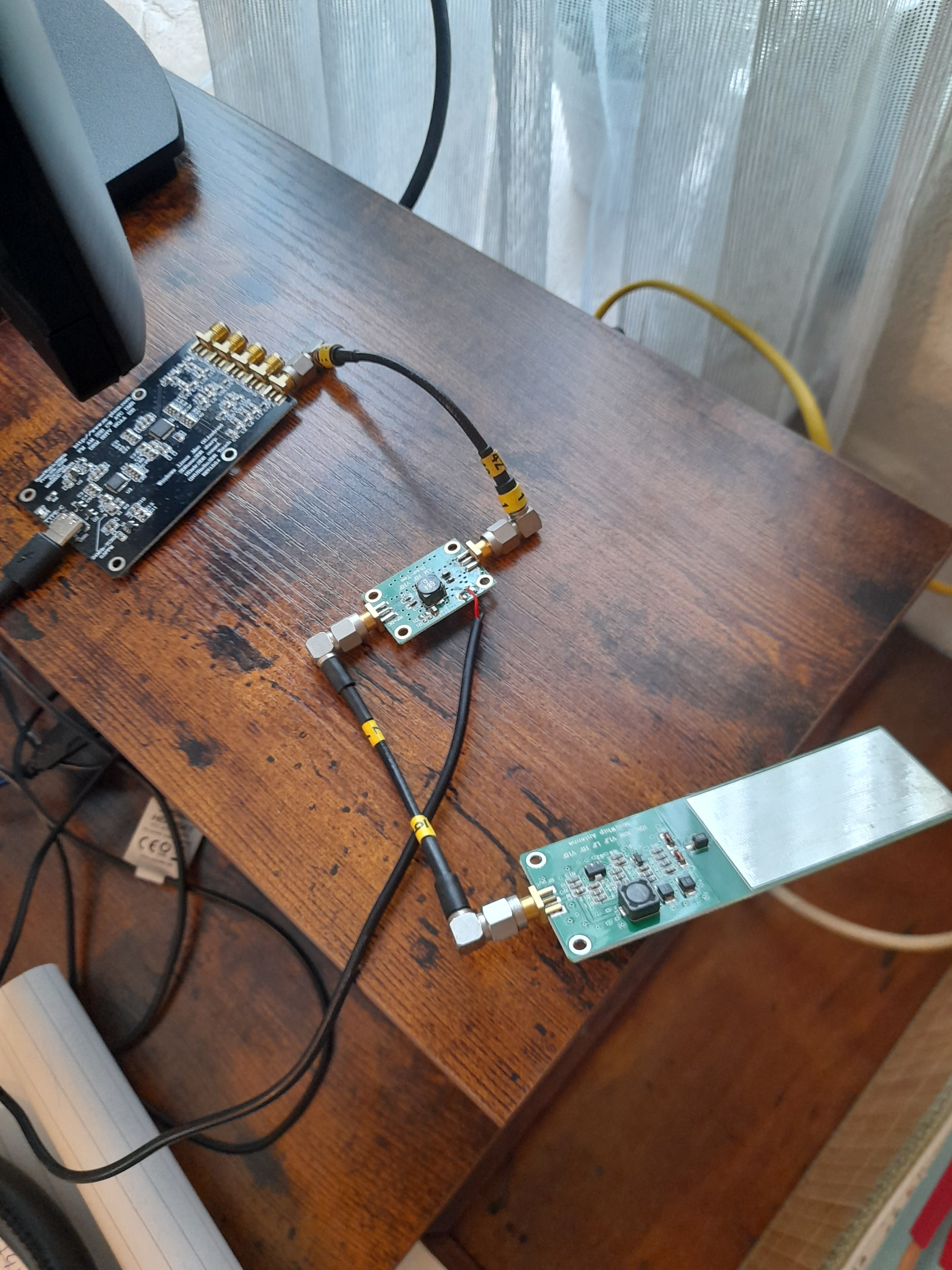
Great fun with SDR Receiver MSI2500 in combination with SDRuno software. I am exploring  the possibilities of this nice toy.

The SDR receiver (frequency range 30 - 1000 MHz) has 5 antenna inputs each with its own bandfilter

SDRuno software in action ( Repeater PI2NOS, 430.125 MHz selected)


Experiment with E-field antenna for low frequency signals (< 10 MHz ).


I wrote an article for the Dutch radiomagazine Electron, NL-Post, Nov. 2023, about this SDR receiver:


Saturday, 10 June 2023

Sun

Yesterday evening I witnessed the sunset from my backyard garden.

I realized that it is amazing that a star at a distance of 150 million kilometers from us affects the propagation of radio signals on earth. During daytime the solar wind presses the Kennelly-Heaviside layer closer to the earth, thereby limiting how far it can reflect radio waves. The effect is also influenced by the amount of sunspot activity.

Sunset yesterday from Zuidzijde