Tuesday, 26 August 2014

Canadian industrial heritage

A nice surprise this morning in the office. A collegue showed some beautiful pictures of Canadian industrial heritage. Allthough off-topic, I would like to share these pictures which Guy took during his recent visit to the Heritage Park in Calgary, Alberta (Canada). Amongst others, they show steam locomotive 0-6-0, CPR2023 of the American Locomotive Company, Shop No 70388, manufactured in Sep. 1942.


More info about the park: https://www.heritagepark.ca


This week I came accross railway station "Geldermalsen" which is being reconstructed. 

Saturday, 16 August 2014

eQSL from Senegal

eQSL sometimes really surprises me. This week I got this eQSL from Peter, 6W2SC.
The card confirms a 20m RTTY QSO back in 2006 :-)
QSO's with Africa are very rare anyway because of the simple fact that people can not afford money spent on a hobby. Therefore the number of radio amateurs is not high and I treasure each QSO made with Africa.


Casamance, Senegal:


Saturday, 9 August 2014

23 cm ATV transmitter works

This week I did some succesful experiments with the 23 cm FM ATV transmitter with ALPS VCO. The transmitter provides about 30 mW to an 23 cm PA which delivers 1...2 Watts at 1.2 GHz. One of the tranmissions shows my testpicture at the PI6ZTM repeater:


I did not include PLL circuitry in the design. The circuit is straight forward:


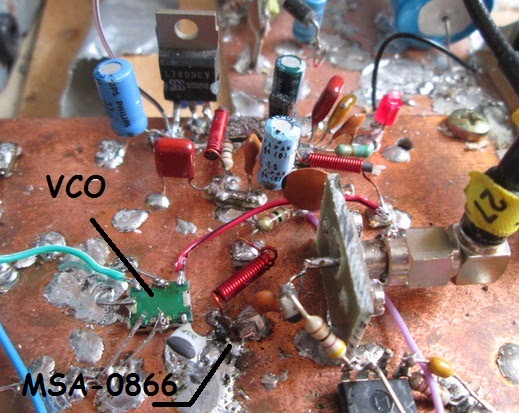
The video branch contains: CCIR-filter, VCO ALPS 1679C and MMIC MSA-0886.

August 12, I was able to test the audio part (7.02 / 7.2 MHz oscillator). It worked, but there was some 50/100 Hz hum. Also I found that results were better when the 7 MHz signal was injected just after the 50 k potmeter.

The VCO can be tuned from 1100...1350 MHz.

At this moment, the experimental circuit is soldered on unetched PCB.


                                             23 cm ATV transmitter

The ATV transmitter is connected to the Power Amplifier (design PA0VRE):

                                                    2 Watt PA with BFQ68 and BFQ136

The PA delivers its output signal to a homemade biquad antenna, connected with about 8 meters RG6U coaxial cable (75 ohms).

More testpatterns:


To my surprise the transmitter is very frequency stable. No PLL circuit required !

Saturday, 2 August 2014

Handycam

On a fleemarket I found a nice, old camrecorder to provide me with moving images for ATV experiments.
It is a Sony Handycam from around 1990. It is a camera/recorder using Video 8 tapes. At the time a revolutionary device because of its palm sized dimensions and good picture quality.


The Handycam delivers a composite video signal (yellow cinch plug) which I can feed directly into the ATV transmitter (with the ALPS VCO)

Sony still uses the brandname "Handycam" for its current digital cameras:

http://en.wikipedia.org/wiki/Sony_Handycam_NEX-VG10

All about the Sony Handycam:

http://en.wikipedia.org/wiki/Handycam

Recording made with Handycam transmitted on 1.2 GHz

Sunday, 27 July 2014

ALPS VCO at work

The ALPS VCO 1679C is operational. Power supply and tuning voltage have been connected now. Also a small MMIC, the MSA-0866 from Hewlett Packard has been connected to the output to increase the output level from about 0 dBm to abt. 12 dBm. 
I viewed the spectrum on the SDR receiver and found I could generate a stable signal in the 23 cm band. Here you see a clean signal around 1.256 GHz:


The VCO can be tuned between 1100 and 1350 MHz. I think the long and short term stability are good enough to use the free running VCO for 23 cm ATV transmission. No PLL required !


MSA-0866 data:


Friday, 18 July 2014

ALPS VCO

In my post of June 29, I described a trial to make an oscillator which generates an EM-signal with a frequency higher than 1 GHz. The circuit, in which a BFR96 was used, did work, but the oscillator appeared to be rather unstable. Certainly not stable enough to form the core of a simple 23 cm FM  TV transmitter I want to design. Also I do not want to waste time trying to make the design stable by using frequency divider/PLL circuitry. My experience with PLL circuits is not very good.

In my search on the internet for a stable VCO, I found the ALPS 1679C at Kingcom and ordered one ( kingcom(at)chello.nl ). 

This VCO has a frequency range of 1100 - 1350 MHz. This covers the 23 cm HAM band (1240 - 1300 MHz). The VCO provides 1 mW RF output (0 dBm into 50 ohms).
I am curious to find out how this little device behaves.


Saturday, 12 July 2014

50 MHz radio propagation to Morocco

A nice surprise this morning.
My 50 MHz WSPR signals reached Rabat, Morocco. Said, CN8LI, picked up my signals and vice versa I saw his signal in Holland a couple of times;


Distance was over 2200 km and I used 10 Watts, probably too much for WSPR...


This is my second best distance for the 6 meter band. A couple of weeks ago my signal was decoded in Israel (> 3000 km).

                                                               Rabat, Morocco


Improved sensitivity ADS-B receiver

With a simple dipole antenna it was easy to improve the receive results of the ADS-B receiver. I soldered two elements of about 6 cm to a coaxcable which is connected to the TVdongle. Results were great:

With DVB-T antenna; Less than 10 aircraft:

                                              DVB-T antenna (not tuned to 1090 MHz)


                                       With dipole antenna; over 30 aircraft:


Dipole with two quarter wavelength elements

Also the range is greater. I have seen aircraft near the London area 


Saturday, 5 July 2014

ADS-B receiver operational

No hot solder iron required for this project. 
This morning, I have been able to capture aircraft flying above me by receiving their
ADS-B 1090 MHz signal. For this purpose the SDRsharp dongle is used. See my blog article of 7 June. All the "ins" and "outs" of ADS-B (Automatic Dependent Surveillance Broadcast) can be found on the internet. For example here: http://nl.wikipedia.org/wiki/ADS-B

I followed the intructions of the "Sterrenwacht Leeuwarden" and installed "RTL1090 beta 3" and "Globestrl" succesfully.

http://www.sterrenwachtleeuwarden.nl/adsb%20ADS-B%20luchtvaart%20radar.html

Now I can watch "real-time", without internet connection, the aircraft flying above the
western part of The Netherlands:


RTL1090 Beta3 version 

Globe-S, aircraft trajectories on July 5 abt 14:00 hr local time

On top of my PC on the righthand side you see the small antenna (which is designed for television  DVB-T reception) and the RTLsdr dongle inserted in the upper USB port 

Interesting to see how an ADS-B signal looks like in the frequency domain:


More ADS-B software: http://rtl1090.web99.de/

Friday, 4 July 2014

HG receiver in "Razzies"

"Razzies" is a magazine (in Dutch language) that is published by the radio amateurs in Zoetermeer: www.pi4raz.nl
It was good to see that my article about the "Hollands Glorie" receiver was published
in the July 2014 version of "Razzies".
You can download "Razzies" via this link: http://www.pi4raz.nl/razzies/