Thursday, 29 May 2014

First results "Hollands Glorie" receiver

Today I made good progress with the construction of the "Hollands Glorie" receiver. See my blog posting of May 18 for the circuit diagram. 
I succeeded in making a replica of the 402 Amroh coil. 


                                        Original Amroh 402 coil. Hard to get !

This coil is very hard to find these days. I made a replica bij using a ferrite rod with two handwind coils.
                              Details necessary to build the replica 402 on ferrite core


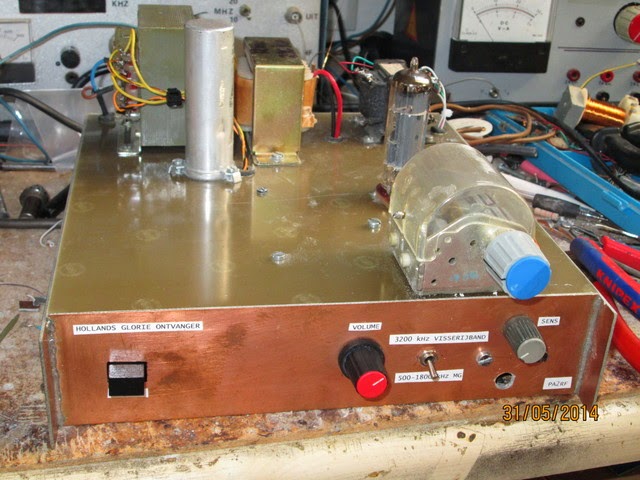
The replica 402 is located on the lefthand side of the solderingboard (attached with two tyreraps). After connecting the coil the power was switched on and after a minute there was music! Up till now I have heard 4 different Dutch broadcast stations on the medium wave. The 90 m band (where the fishermen used to communicate, long, long time ago) however does not give sounds (except for lots of noise). 
Anyway I am happy with this result. While I am typing this the radio is tuned to "Radio 5, Nostalgia", on 747 kHz AM.  I am curious to see if more stations (from the rest of Europe) can be detected when the sun has dissappeared.


In the evening of May 30, 2014 with a 8 meter long wire into the garden as antenna I was able to listen to 10 stations: 
Dutch (4x), English (2x), French (1x), German (1x), East-European (2x). This is better than expected. I thought most of the AM broadcast stations had dissappeared. During the day only following 4 Dutch stations can be heard (even with the long wire antenna):
 
Radio Maria NL, 675 kHz
NPO Radio 5 Nostalgia, 747 kHz
Groot Nieuws Radio, 1008 kHz
Vahon Hindustani Radio, 1566 kHz
 

Sound quality is ok. Selectivity is fine. There was a small hum which I could solve by installing a 100 ohm resistor between one of the filament connections to ground. I am impressed what can be achieved with a one-tube design. 


Fisherman; copied from the original "Dr. Blan" article in 1963

Saturday, 24 May 2014

New camera

Most pictures on this blog have been taken with a 4 Mpixel camera of my Samsung Galaxy Young. It is easy to improve the quality of the pictures taken with this smartphone.

Last weekend I got a new camera; a Canon Powershot A3500IS.
This is a compact camera making 16 Mpixel pictures. A nice feature is the WiFi capability which enables you to upload pictures to the PC without cable. 
I have to explore all the features this little device has.
Anyway, picture quality on this blog will certainly change.


This camera will be added to the list of cameras that can make use of the CHDK (Canon Hack Development Kit)  

Update May 25, 2014. Some pictures taken today with the Canon near the village of "Gelderswoude".


Sunday, 18 May 2014

"Hollands Glorie" receiver

In 1978 I built the " Hollands Glorie"  receiver as published in the Amroh issue of "Jongens Radio" in 1969. I do remember I was so impressed by the results of this one tube receiver at the time. I have decided to re-build the receiver to see how it behaves in 2014.

Instead of the original ECL86 I will use the PCL86 (14.5 Volts filament voltage)

PCL86

I do not have the original 402 Amroh core. So I have to re-engineer and re-build the coil.

Circuit receiver


Progress until now is as follows:


To my surprise on the www I found an article about the receiver in a "Dr. Blan" publication, on which the article in "Jongens Radio"  was based:


Sunday, 11 May 2014

70 MHz propagation

Yesterday I switched on the 70 MHz transverter. After some hours I found a couple of Dutch  stations that detected my 5 Watt WSPR signal on 70.0926 MHz:


My signal was heard by PA0O, PA3EGO and PA7EY/1. Unfortunately there are not a lot of 4m WSPR stations. I hoped to be heard in the UK since yesterday some English 4m WSPR stations were active. 
Propagation conditions were not good enough to cross the Northsea this time. Maybe in a couple of weeks when better tropo or even Es comes available.


As you can see G3MXH was heard in the northern part of the Netherlands by PA0O. So WSPR sigs did cross the Northsea but my indoor antenna probably performs not good enough to capture the tiny radio waves.

Friday, 9 May 2014

K150 PIC programmer arrived

As I informed you April 17, I ordered a "K150 PIC programmer" from eBay for about $10.
The unit arrived this week. As promised it was delivered with USB cable and ICSP ("In Circuit Serial Programming") flatcable.


I connected the programmer to a free USB port on the PC and installed drivers and the small Microburn program. After trying some COM settings, it appeared I had to use COM "3".
Up till now, I have been able to succesfully program three different PICs: a 16F628A, 12F675 and 16F877.


Free "Microburn" program:


Very nice-priced and useful product !

Thursday, 1 May 2014

Wednesday, 30 April 2014

PI6ZTM antennas at 66 meters altitude

This is a picture taken from the top of the "Blankaard". On top of this building is the location of the antennas of the ATV repeater PI6ZTM in Zoetermeer. At an altitude of 66 meter it provides an excellent overview of the surrounding area.
My attention was attracted by the horizontal polarized 23 cm 4 x double-quad antenna (the white box in the middle). It is good to see this 23cm antenna setup which made reception of my small 1255 MHz ATV signal possible.


All tech details can be found here:
http://www.pi6ztm.nl/index.php/technische-informatie

Sunday, 27 April 2014

CW paddle

Unfortunately I do not "speak" morse. In the past I tried to learn it several times, but I never managed to control morse. For training excercises I once built a CW paddle. It is a rather easy design. You only need some unetched PCB and small material.
I remember it was great fun to construct it.
By the way, I sometimes make CW QSOs while using computerprogramms like CWget. But that is not really fair :-)


Thursday, 24 April 2014

35 MHz frequency counter

One of the most useful tools for a radio operator is a frequency counter. With PIC's available these days it is not that difficult to build one yourself. The counter presented here makes use of a 1x16 character display HD44780. 
Those displays are for sale for appr. $2.50 at eBay. A PIC 16F628A, a 4 MHz xtal and some discrete components is all you further need.


The design comes from Asia: http://www.hamradio.in/circuits/freq_counter_lcd.php
The HEX-code for the PIC is shown at the bottom of the webpage. The design allows you to set a lot of different IF frequencies (including IF = 0 Hz).


I was really surprised to see that the counter could measure frequencies much higher than 35 MHz. In this case a frequency in the 4 meter band (70 MHz) is shown.  


Note: According to Rinus Jansen from Kent Electronics the higher max. input frequency can be explained by the fact that a -628A pic instead of the old -84 pic is used.

Friday, 18 April 2014

Radio Twenthe

Yesterday we went to the city of Den Haag to do some shopping.
Since I ran out of unetched PCB-materiaal and miniature switches I took the opportunity to buy some at the only electronics shop in the neighbourhood: Radio Twenthe at the Stille Veerkade.


Till some years ago in the area we had some nice shops with electronics: Radio Ster, Stuut & Bruin in Den Haag, Kok in Leiden, Radio Display in Utrecht. Since the lack of interest in homebuilding has increased and the possibility to buy components on the internet (eBay, marktplaats, dx.com etc. etc.) all those shops dissappeared.


As far as I remember Radio Twenthe has always been there; the owner told me that around 1960 the business started. They still have a large collection of vacuum tubes, DIY building kits, loudspeakers, switches, transformers, wiring etc.


Advertisement 1971:


You can approach Radio Twenthe via their (limited) website:
http://www.radiotwenthe.nl/